

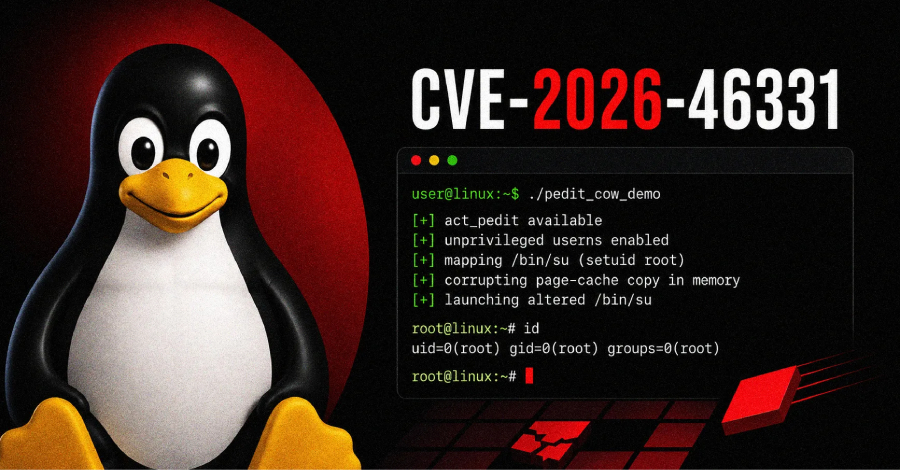
New Linux Page Cache Poisoning (COW) Exploit Enables Root Access
A new class of Linux privilege-escalation vulnerability has emerged, allowing local attackers to gain root access by exploiting a race condition in how the kernel handles copy-on-write (COW) behavior and page cache memory. The issue follows a familiar pattern seen in previous exploits such as Dirty Pipe, Dirty COW, Dirty Clone, and Dirty Frag — but introduces a new and more accessible attack surface.
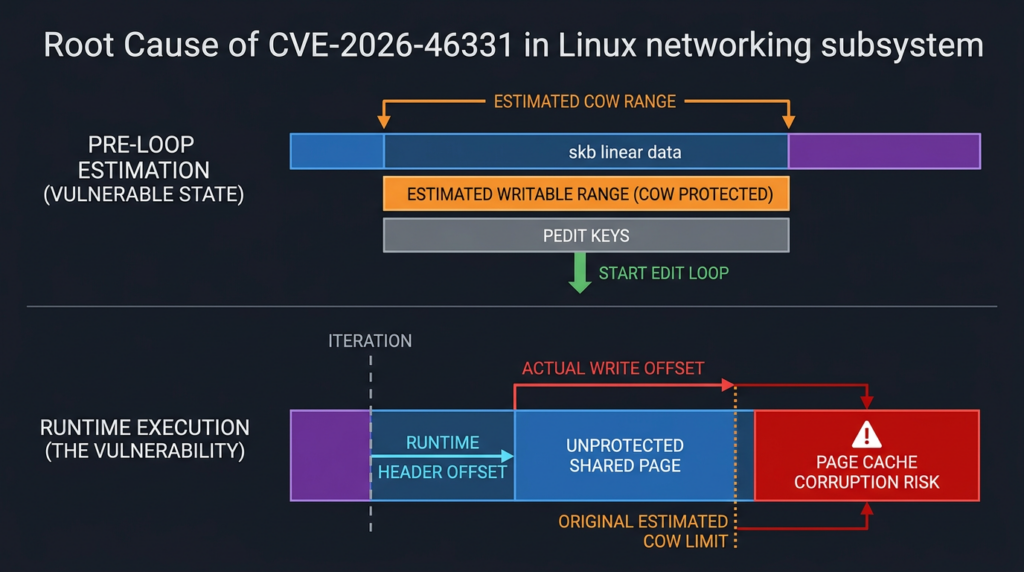
At its core, the vulnerability stems from a subtle mismatch in how the kernel validates write boundaries during certain fast-path operations. In some cases, the writable range is checked too early, before all runtime offsets are fully resolved. When those offsets are later determined, the write may extend beyond the expected private buffer.
Instead of remaining isolated in a private copy, the write can land in a shared page cache region. If that page corresponds to a cached file, the attacker effectively corrupts the in-memory representation of that file — enabling manipulation of executable binaries or sensitive system data.
Why This Exploit Pattern Matters
This is not an entirely new category of bug. Linux kernel history has repeatedly shown that fast-path optimizations in memory management can lead to privilege escalation when ownership rules are incorrectly enforced.
The shared structure across these exploits is consistent:
- A kernel path assumes exclusive access to a memory page
- That assumption becomes invalid under specific timing or namespace conditions
- A shared page cache entry is modified instead of a private copy
What makes this case notable is not the memory corruption itself, but the entry point that makes it practical.

The New Attack Surface: User Namespaces + tc Actions
The exploit reportedly becomes viable through traffic control (tc) configuration from within unprivileged user namespaces.
In environments where unprivileged user namespaces are enabled, an attacker can escalate privileges locally by leveraging CAP_NET_ADMIN capabilities granted inside the namespace boundary. This expands the attack surface significantly, especially on systems that rely on container workloads or sandboxed environments.
As a result, systems that appear properly isolated may still expose a path to kernel-level exploitation.
Affected Systems
Based on early reports and proof-of-concept testing, multiple major Linux distributions are affected:
- Debian 13 (trixie): vulnerable, with fixes rolling out via security updates
- Debian 11 and 12: still listed as vulnerable
- Ubuntu 18.04 – 26.04: affected in supported releases, depending on configuration
- RHEL 8, 9, and 10: affected according to vendor advisories
- RHEL 7: not listed as affected in current reports
Some mitigations depend on configuration rather than kernel version alone. For example, Ubuntu 26.04 reduces exposure by restricting user namespaces via AppArmor policies, though the underlying kernel vulnerability may still exist.
Mitigation Strategies
The primary recommendation is straightforward: apply the patched kernel and reboot as soon as possible.
However, in high-risk environments, additional mitigation steps may be considered:
Disabling unprivileged user namespaces can block the exploit path entirely:
kernel.unprivileged_userns_clone=0(Debian/Ubuntu)user.max_user_namespaces=0(RHEL-based systems)
This significantly reduces attack surface, but comes with trade-offs. It can break or limit:
- Rootless containers
- CI/CD sandboxing environments
- Some browser and application sandbox features
For production systems, this should be tested carefully before deployment.
Why Detection Is Difficult
One of the more concerning aspects of this vulnerability is that it targets the page cache in memory, not persistent storage. That means traditional file integrity monitoring tools may not detect the modification.
Even clearing the cache (for example via drop_caches) does not remove an attacker’s already established foothold — such as a spawned root shell or modified process state.
In practice, once exploitation is confirmed, the system should be treated as compromised and rebuilt or restored from a trusted state.
Disclosure Timeline Concerns
The vulnerability reportedly appeared on the netdev mailing list as a routine bug fix related to data corruption, without an immediate security classification. A CVE was only assigned after the patch was merged.
Shortly after public disclosure, proof-of-concept exploitation code followed quickly, highlighting a recurring issue in kernel security: the time between technical disclosure and weaponization is often extremely short.
For kernel-level vulnerabilities affecting page cache or memory management paths, relying on delayed detection or signature-based scanning is no longer sufficient.
Conclusion
This vulnerability reinforces a long-standing reality in Linux security: most kernel privilege escalations do not come from exotic new bugs, but from subtle assumptions in complex memory and concurrency systems.
Copy-on-write mechanisms, page cache sharing, and namespace-based privilege models all interact in ways that are difficult to reason about — and even harder to secure by configuration alone.
The safest response remains consistent across all similar classes of vulnerabilities:
Keep systems patched, reduce unnecessary kernel attack surface, and treat untrusted local execution as a first-class security boundary.
