

2026 Embedded Systems Trends: Less Hype, More Consequences
Every year, the same question comes up:
“What embedded systems trends should I pay attention to?”
Most answers tend to recycle the same mix of buzzwords, vendor roadmaps, and technologies that sound promising in slides but rarely survive contact with a real firmware project.
What’s different heading into 2026 is that the industry is no longer driven primarily by novelty. It’s being shaped by consequences — the accumulated result of how embedded systems have been built for the last decade.
And many teams are not fully prepared for that shift.
Embedded Systems Haven’t Changed — But Expectations Have
The uncomfortable reality is this:
Most embedded software is still built in ways that haven’t fundamentally changed in 10–15 years.
- Monolithic firmware designs
- Hardware-first thinking instead of system-first design
- Late-stage testing instead of continuous validation
- Security treated as an add-on
- Tooling designed for single-board, single-product development
At the same time, expectations have changed dramatically.
Modern embedded products are expected to:
- Ship faster and iterate continuously
- Support multiple hardware variants
- Receive updates in the field
- Meet increasing regulatory requirements
- Integrate AI-driven features
- Stay secure for years
- Scale across product lines and generations
This mismatch between legacy development practices and modern expectations is what is actually driving the trends in 2026 — not any single technology breakthrough.
Trend 1 — AI Isn’t Replacing Firmware Engineers, It’s Exposing Weak Processes
AI is the most talked-about force in software right now, but in embedded systems its impact is often misunderstood.
AI is not transforming firmware by magically generating perfect low-level code. Instead, it is amplifying whatever development process already exists.
If your system is well-structured — modular, testable, and clearly designed — AI becomes a force multiplier. It helps teams:
- Understand unfamiliar codebases
- Summarize architectural intent
- Generate internal tooling
- Explore design alternatives
- Review changes for consistency
But if your system is already fragile — tightly coupled, poorly documented, and dependent on tribal knowledge — AI does not fix it. It exposes it.
In practice, AI is not replacing engineers. It is separating teams with disciplined architecture from those relying on implicit knowledge and accumulated complexity.
Trend 2 — Edge AI Is Returning, But Now It Must Justify Itself
Edge AI is not new. Neural networks have been running on microcontrollers for years. What has changed is economics.
Modern MCUs now include:
- Dedicated ML accelerators
- DSP extensions
- Increased RAM for inference workloads
- Lower power profiles enabling always-on intelligence
At the same time, cloud inference costs, bandwidth constraints, and latency requirements are pushing intelligence closer to devices.
But edge AI is not just a feature upgrade — it is an architectural commitment.
Once a system includes local inference, it inherits new responsibilities:
- Model versioning and lifecycle management
- Secure update mechanisms for models
- Validation pipelines for behavioral changes
- Power and thermal budgeting
- New classes of failure modes
In 2026, successful edge AI deployments will not be defined by model sophistication, but by system design. The winning teams will treat intelligence as part of the architecture, not an add-on.
Trend 3 — Security Is No Longer Optional
Embedded security has historically been treated as a “later” problem — something to address after functionality is complete.
That approach is no longer viable.
Regulation, especially in Europe, combined with increasing connectivity, has pushed security into the center of embedded design. As a result, teams are now forced to confront foundational questions earlier:
- How is the system booting securely?
- How are updates authenticated?
- Where are cryptographic keys stored and managed?
- What is the hardware root of trust?
- What does the threat model actually look like?
These are not features that can be added later. They define system architecture from the beginning.
Security is no longer a differentiator between good and great products. It is a baseline requirement for viability.
Trend 4 — Platform Thinking Is Replacing Project Thinking
One of the most significant but less visible shifts in embedded development is organizational.
Teams are increasingly realizing they are no longer building isolated products. They are building platforms.
Most embedded systems today:
- Exist in multiple hardware variants
- Share large portions of code across products
- Require long-term maintenance and updates
- Serve multiple customers or markets
- Persist for 10+ years in the field
This reality breaks the traditional model of “one firmware per product.”
Instead, teams are moving toward:
- Shared system architectures
- Reusable software components
- Configuration-driven behavior
- Strong hardware abstraction layers
- Reproducible and standardized build systems
Modern RTOS and embedded Linux ecosystems are accelerating this shift, not because of the OS itself, but because they promote modularity, reproducibility, and long-term maintainability.
Trend 5 — Architecture Is Becoming a First-Class Concern Again
For a long time, architecture in embedded systems was treated as overhead — something secondary to “getting it working.”
That mindset no longer scales.
In 2026, architecture is resurfacing as a critical concern because:
- Teams are distributed across locations
- Products have long lifecycles
- Regulatory constraints require traceability
- AI tools depend on structured systems
- Security requires clear boundaries and isolation
Good architecture is no longer about documentation or diagrams. It is about enabling change without introducing fear or instability.
In other words, architecture is becoming the difference between systems that evolve and systems that collapse under their own complexity.
The Real Trend: Embedded Systems Are Growing Up
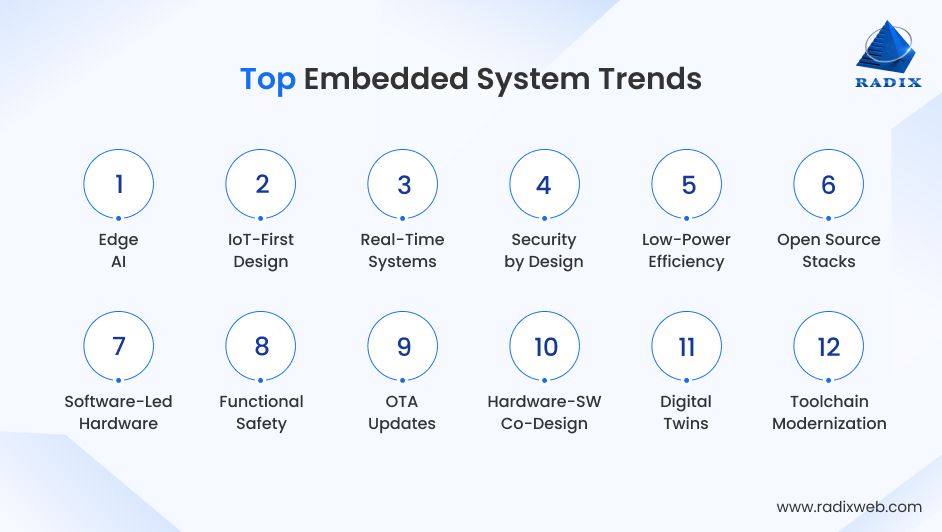
If all of these trends point in one direction, it is this:
Embedded systems are finally being treated as long-lived software platforms.
Not prototypes.
Not isolated firmware projects.
Not hardware demos with code attached.
But evolving software systems that must remain maintainable, secure, and adaptable over time.
This shift changes everything:
- How systems are designed
- How they are tested
- How teams are organized
- How tools are chosen
- How success is measured
And importantly, it is not being driven by hype.
It is being driven by reality.
Final Thought
The teams that struggle in 2026 will not be the ones who missed a trend.
They will be the ones who continued building embedded systems as if nothing fundamental had changed.
The teams that succeed will recognize a simple truth:
The hardest part of embedded systems is no longer the hardware.
It is designing the software, architecture, and processes that allow systems to evolve safely over time.
That is the real trend.
