


Embedded Linux Security: Best Practices for System Hardening in 2026
Embedded Linux powers millions of connected devices, from industrial controllers and medical equipment to automotive systems, networking hardware, smart home products, and edge AI devices. Its flexibility, open-source ecosystem, and extensive hardware support have made it the operating system of choice for modern embedded products.
That popularity also makes it one of the most attractive targets for attackers.
Today’s embedded devices rarely operate in isolation. They connect to cloud services, communicate with mobile applications, exchange data with other machines, and often remain deployed in the field for years. Every network interface, software package, and exposed service increases the attack surface, making security no longer an optional feature but a fundamental engineering requirement.
Hardening an embedded Linux system is about much more than enabling a firewall. It requires reducing unnecessary complexity, enforcing strict access control, protecting the boot process, maintaining software throughout the device’s lifetime, and assuming that attackers will eventually attempt to compromise the system.
This guide explores the most effective strategies for securing Embedded Linux systems in 2026.
Why Embedded Linux Security Matters
Connected embedded devices have become critical infrastructure. A vulnerability inside an industrial controller can halt manufacturing. A compromised automotive ECU can affect vehicle safety. An insecure medical device can expose sensitive patient data or disrupt clinical operations.
Unlike desktop computers, embedded products typically remain deployed for five, ten, or even fifteen years. During that time, new vulnerabilities continue to emerge while the hardware remains unchanged.
The challenge is even greater because embedded systems often operate with limited CPU resources, restricted memory, intermittent connectivity, and strict real-time requirements. Security controls must be effective without compromising system performance or reliability.
Attackers increasingly target embedded Linux because compromising a single device can provide access to larger networks, cloud services, or entire IoT deployments.
For manufacturers, security is no longer just about protecting software—it is about protecting the entire product lifecycle.
Reduce the Attack Surface
The first principle of embedded security is simple: software that does not exist cannot be exploited.
Many Linux distributions include dozens of services intended for general-purpose computers. Embedded products rarely require all of them. Every unused daemon, library, or package represents additional code that must be maintained, patched, and monitored.
A hardened system begins with a minimal root filesystem.
Only install the components required for the product’s functionality. Remove development utilities, unused networking services, debugging tools, package managers, compilers, and example applications before production deployment.
Disable services that start automatically but are never used. Close every unnecessary network port. If a service only needs to communicate internally, bind it to localhost instead of exposing it to every network interface.
A smaller software footprint not only reduces the number of vulnerabilities but also simplifies long-term maintenance and compliance.

Secure the Boot Process
Protecting the operating system starts long before Linux begins executing.
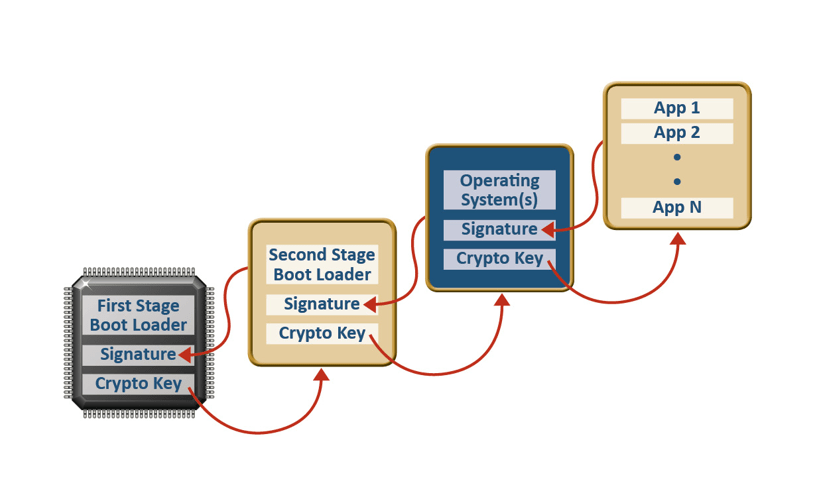
Secure Boot establishes a chain of trust from the hardware boot ROM through the bootloader, Linux kernel, device tree, and root filesystem. Each component verifies the integrity and authenticity of the next before execution continues.
Without Secure Boot, an attacker with physical access—or even temporary access during servicing—can replace the kernel or bootloader with modified software that bypasses every security mechanism inside the operating system.
Modern embedded platforms should also support verified firmware updates, rollback protection, and cryptographically signed images to prevent unauthorized software from being installed.
A secure operating system cannot exist without a secure startup process.
Enforce Least Privilege
Many embedded products still run applications as the root user because it appears simpler during development.
In production, this dramatically increases the impact of any software vulnerability.
Every application should execute with only the permissions necessary for its specific function. Separate system services into dedicated users and groups, restrict filesystem access, and avoid granting unnecessary capabilities.
Linux capabilities provide a far more granular alternative to full root privileges. Instead of granting unrestricted administrative access, applications can receive only the specific kernel capabilities they require.
Mandatory Access Control systems such as SELinux or AppArmor provide another important layer of defense. Even if an attacker successfully exploits an application, security policies can prevent access to sensitive files, network interfaces, or other processes.
The goal is not to prevent every compromise.
It is to ensure that one compromised process does not become a compromised device.
Protect Remote Access
SSH remains one of the most common entry points into embedded Linux systems.
Unfortunately, it is also one of the most commonly misconfigured.
Password authentication should be disabled wherever possible in favor of public-key authentication. Multi-factor authentication should be enabled for administrative systems whenever practical.
Default credentials should never exist on production devices.
Rate limiting, intrusion prevention, IP allowlists, and login monitoring further reduce exposure to automated attacks and credential stuffing.
Remote management interfaces should only be enabled when required and ideally isolated behind VPNs or dedicated management networks rather than exposed directly to the public internet.
Keep Software Updated
Security is not something implemented once during development.
It must continue throughout the product’s entire operational life.
Every Linux kernel release, bootloader update, and third-party library introduces new fixes for recently discovered vulnerabilities. Without a reliable update strategy, devices become progressively less secure over time.
Modern embedded systems should support secure Over-the-Air (OTA) updates with cryptographic verification, rollback protection, and failure recovery mechanisms.
A/B partitioning has become a common approach because it allows devices to safely update inactive partitions while preserving a known-good fallback image if installation fails.
Organizations should also maintain an inventory of software components and continuously monitor published CVEs affecting their products.
Secure the Software Supply Chain
Most embedded Linux products contain far more third-party code than proprietary code.
The Linux kernel, BusyBox, OpenSSL, systemd, Qt, Python, OpenSSH, package managers, and countless libraries all become part of the device’s software supply chain.
Each dependency introduces potential vulnerabilities.
Maintaining a Software Bill of Materials (SBOM) allows manufacturers to identify affected components quickly when new security advisories are published.
Reproducible builds, signed packages, dependency verification, and trusted repositories reduce the risk of supply chain attacks while simplifying regulatory compliance.
Supply chain security has become just as important as operating system security itself.
Monitor System Integrity
Prevention alone is never sufficient.
Systems should continuously monitor their own health and detect unexpected behavior before attackers achieve persistence.
File integrity monitoring can detect unauthorized changes to system binaries or configuration files. Runtime monitoring helps identify suspicious processes, privilege escalation attempts, unexpected network connections, or abnormal resource consumption.
Centralized logging ensures valuable forensic information survives even if the device itself becomes compromised.
Where connectivity allows, security logs should be transmitted to remote monitoring infrastructure rather than stored exclusively on the local filesystem.
Detection dramatically reduces the time between compromise and response.
Harden the Linux Kernel
The kernel forms the trusted computing base of every Embedded Linux device.
Hardening begins by disabling unnecessary kernel features and drivers that are never used by the target hardware.
Kernel Address Space Layout Randomization (KASLR), stack canaries, Control Flow Integrity (CFI), read-only kernel memory protections, and hardened memory allocators significantly increase the difficulty of successful exploitation.
Seccomp filters can further restrict which system calls applications are permitted to execute, reducing opportunities for privilege escalation.
For highly security-sensitive applications, custom kernel configurations remove thousands of lines of unnecessary code while reducing the overall attack surface.
Secure Containers and Edge Applications
Containers are increasingly common in embedded gateways and edge computing platforms.
However, containers are not security boundaries by themselves.
Minimal container images reduce vulnerabilities by eliminating unnecessary packages and utilities. Containers should avoid running as root and should execute with restricted Linux capabilities wherever possible.
Image signing, vulnerability scanning, runtime monitoring, and read-only filesystems provide additional protection against tampering.
Container security should complement host security rather than replace it.
Design Security Into the Architecture
The strongest security controls are built into the product architecture from the beginning rather than added during final testing.
Security by design means considering authentication, encryption, secure storage, update mechanisms, logging, and threat modeling during system architecture—not after the software is already complete.
Early security decisions are significantly less expensive than redesigning products after vulnerabilities are discovered.
Threat modeling exercises help engineering teams understand how attackers might compromise a system and which defenses provide the greatest reduction in risk.
A secure architecture rarely happens by accident.
Common Hardening Checklist
Before deploying an Embedded Linux device, verify that the system:
- boots only trusted, signed software;
- exposes only required network services;
- enforces least privilege for every application;
- uses secure authentication without default passwords;
- supports secure OTA firmware updates;
- continuously monitors logs and system integrity;
- protects sensitive data through encryption;
- tracks third-party software dependencies;
- receives regular security patches;
- follows a documented incident response process.
These practices establish a strong security baseline that significantly reduces exposure to modern threats.
Final Thoughts
Embedded Linux security is no longer simply about preventing unauthorized access. It is about designing systems that remain resilient throughout years of deployment, software updates, evolving threats, and changing compliance requirements.
No single technology can guarantee security. Firewalls, Secure Boot, SELinux, encryption, intrusion detection, vulnerability management, and secure software updates all address different parts of the attack lifecycle.
Organizations that adopt a defense-in-depth strategy build products capable of resisting not only today’s attacks but also tomorrow’s.
As embedded devices become increasingly intelligent and interconnected, security must be treated as a continuous engineering discipline rather than a feature added before release. The most successful embedded products in 2026 will not necessarily be those with the most features—they will be those that remain secure, maintainable, and trustworthy throughout their entire lifecycle.
