


RTOS vs Embedded Linux in 2026: Where Zephyr Fits—and Where Linux Still Wins
Introduction
Choosing between a Real-Time Operating System (RTOS) and Embedded Linux has become far more nuanced than it was a decade ago. In the past, the decision was mostly based on available memory: if your device had less than 1 MB of RAM, you used an RTOS. If it had more than 32 MB, Linux was the obvious choice.
That rule no longer applies.
Modern RTOS platforms like Zephyr have evolved into feature-rich operating systems capable of running advanced networking stacks, secure communication protocols, Bluetooth, and cloud connectivity. At the same time, Embedded Linux, especially with PREEMPT_RT, has significantly improved its real-time capabilities, making it suitable for applications that once demanded dedicated RTOS solutions.
Today, the decision is less about what each operating system can do and more about choosing the right balance between latency, hardware resources, ecosystem maturity, development speed, maintenance, and long-term product support.
This guide compares Zephyr, FreeRTOS, and Embedded Linux to help engineers select the best platform for modern embedded products.
What Is an RTOS?
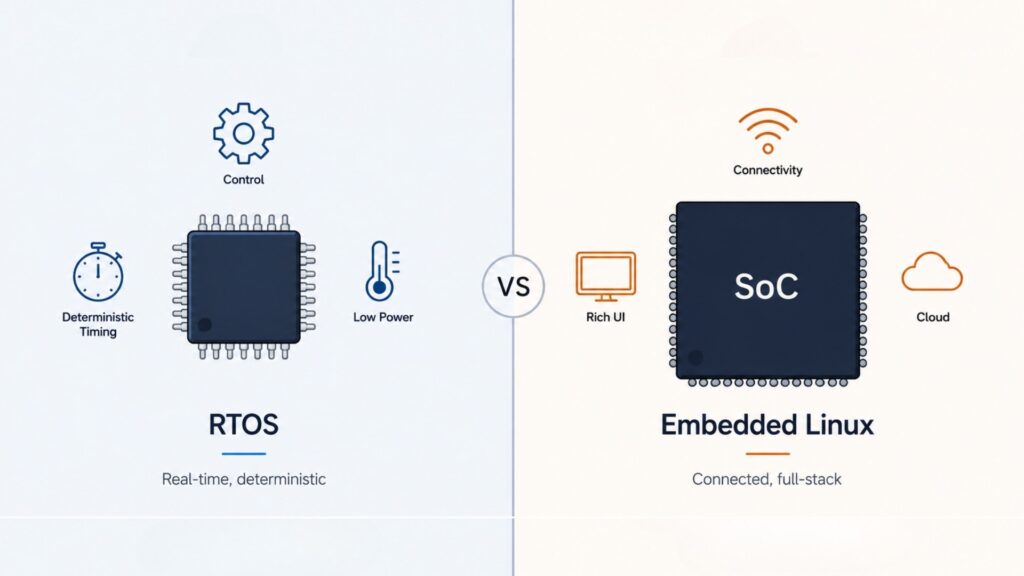
A Real-Time Operating System is designed for applications where timing is critical. Unlike traditional operating systems, an RTOS guarantees that tasks execute within predictable time limits.
Instead of maximizing overall throughput, an RTOS prioritizes deterministic behavior.
Modern RTOS solutions include:
- Zephyr
- FreeRTOS
- ThreadX
- RTEMS
These systems are commonly used in:
- Industrial automation
- Medical devices
- Automotive electronics
- Robotics
- IoT sensors
- Motor control
- Wearable devices
Advantages of an RTOS
Deterministic Scheduling
The biggest advantage of an RTOS is predictable execution.
Every interrupt, task switch, and scheduling event happens within a known time window.
For example, a properly configured Zephyr system running on a Cortex-M4 at 168 MHz can perform a context switch in under 5 microseconds.
This predictability is essential for systems such as:
- Flight controllers
- Medical equipment
- Industrial robots
- Automotive braking systems
- Real-time sensor processing
Extremely Small Memory Footprint
RTOS platforms are optimized for resource-constrained hardware.
A complete Zephyr application with networking can operate using approximately:
- 256 KB Flash
- 64 KB RAM
FreeRTOS can run in even smaller configurations when networking and advanced features are not required.
This allows manufacturers to build low-cost products using inexpensive microcontrollers.
Fast Boot Times
Since there is no userspace, package manager, or complex initialization process, RTOS applications boot almost instantly.
Typical startup times range from a few milliseconds to tens of milliseconds.
This is especially important for:
- Automotive electronics
- Industrial controllers
- Battery-powered devices
- Emergency systems
Direct Hardware Access
RTOS applications interact closely with hardware.
Developers can:
- Access registers directly
- Handle interrupts inside application code
- Minimize software overhead
- Achieve extremely low latency
This makes RTOS platforms ideal for hardware-intensive applications.
What Embedded Linux Offers
Embedded Linux targets more powerful hardware and provides a complete operating system environment.
Rather than focusing solely on deterministic timing, Linux emphasizes flexibility, scalability, and software availability.
Massive Software Ecosystem
Linux offers access to one of the largest software ecosystems in computing.
Developers can immediately use:
- Wi-Fi
- Bluetooth
- Ethernet
- Cellular networking
- VPN support
- HTTP servers
- WebSocket libraries
- Databases
- Containers
- Python
- Rust
- Go
- C/C++
Instead of building features from scratch, teams can reuse mature open-source software.
Memory Protection
Most Linux systems run on processors equipped with an MMU (Memory Management Unit).
This provides:
- Process isolation
- Virtual memory
- Improved stability
- Better security
If one application crashes, it usually does not affect the entire operating system.
Professional Development Tools
Linux development benefits from mature debugging tools, including:
- GDB
- strace
- perf
- Valgrind
- SystemTap
- eBPF
These tools dramatically improve development speed compared to traditional bare-metal debugging.
OTA Updates and Package Management
Linux also provides mature infrastructure for:
- Over-the-air firmware updates
- Secure package management
- Remote maintenance
- Container deployment
- Continuous integration pipelines
For connected products expected to remain in service for many years, this is a significant advantage.
Why Zephyr Has Become So Popular
Zephyr has evolved from a lightweight RTOS into one of the most capable embedded operating systems available.
In 2026 it supports features that previously required Embedded Linux.
Modern Networking
Zephyr includes production-ready support for:
- TCP/IP
- IPv6
- TLS 1.3
- MQTT
- CoAP
- LwM2M
Many IoT devices can now communicate directly with cloud platforms without Linux.
Bluetooth
Zephyr includes one of the industry’s strongest Bluetooth Low Energy implementations.
It supports:
- BLE
- Bluetooth Mesh
- Multiple profiles
- Secure pairing
- Low-power operation
Many Bluetooth products now use Zephyr as their primary operating system.
Security
Security capabilities include:
- Secure Boot
- MCUboot
- Trusted Firmware-M
- PSA Certification
- ARM TrustZone-M integration
These features make Zephyr suitable for secure connected products.
Hardware Support
Zephyr supports hundreds of development boards across multiple architectures, including:
- ARM Cortex-M
- RISC-V
- x86
- ARC
Its hardware compatibility continues to expand every release.
Modern Build System
Zephyr’s build environment combines:
- West
- CMake
- Kconfig
Engineers familiar with Linux kernel development will find the workflow familiar.
RTOS vs Embedded Linux Comparison
| Feature | RTOS (Zephyr / FreeRTOS) | Embedded Linux |
|---|---|---|
| RAM | Under 2 MB | Over 16 MB |
| Flash | Under 4 MB | Over 32 MB |
| Boot Time | Less than 100 ms | Around 1 second or more |
| Latency | Under 10 μs | Around 50–200 μs with PREEMPT_RT |
| Networking | MQTT, CoAP, TLS | Full networking stack |
| User Interface | Basic displays (LVGL) | Rich graphical interfaces |
| Package Ecosystem | Limited | Extensive |
| Development Tools | Basic debugging | Full Linux toolchain |
| Security | Strong embedded security | Process isolation, SELinux, containers |
| Updates | MCUboot, custom OTA | Package managers and enterprise OTA |
Where Zephyr Excels
Zephyr is an excellent choice when your product needs:
- Hard real-time performance
- Fast startup
- Small memory footprint
- Low power consumption
- Modern IoT networking
- Secure firmware
- Battery-powered operation
Typical applications include:
- Smart sensors
- Wearables
- Industrial controllers
- Smart home devices
- Medical equipment
- Robotics controllers
Where Embedded Linux Wins
Linux becomes the better option when your product requires:
- Complex networking
- Web browsers
- Multimedia
- Databases
- Multiple applications
- Rich graphical interfaces
- AI inference
- Containers
- Remote administration
Examples include:
- Smart gateways
- Industrial edge computers
- Medical imaging devices
- Automotive infotainment
- AI edge servers
- Network appliances
Hybrid Architectures
Many modern embedded systems combine both operating systems.
Asymmetric Multiprocessing (AMP)
A common architecture runs:
- Linux on Cortex-A processors
- Zephyr on Cortex-M cores
The Linux processor handles:
- User interface
- Networking
- AI
- Cloud communication
Meanwhile, Zephyr manages:
- Sensors
- Motor control
- Real-time interrupts
- Safety-critical operations
Communication typically uses:
- RPMsg
- OpenAMP
- Shared memory
This architecture provides the best balance between flexibility and deterministic performance.
Separate Processors
Some products physically separate responsibilities.
A microcontroller running Zephyr handles:
- Safety logic
- Real-time control
- Hardware interfaces
A second processor running Linux manages:
- Applications
- Connectivity
- User interfaces
- Cloud services
This design is common in automotive, industrial automation, and medical equipment because it improves safety and fault isolation.
Linux with PREEMPT_RT
For applications that require only soft real-time performance, Linux with PREEMPT_RT may eliminate the need for an RTOS.
Typical worst-case latency ranges from 50 to 200 microseconds, making it suitable for:
- Industrial automation
- Audio processing
- Robotics
- Motion control
- Data acquisition
Long-Term Support
Maintenance is often overlooked during product design but becomes critical over a device’s lifetime.
Embedded Linux
- Linux LTS kernels receive security updates for approximately six years.
- Yocto LTS releases are supported for around four years.
- Large open-source communities provide rapid security patches.
Zephyr
- LTS releases receive approximately 2.5 years of maintenance.
- Security improvements are delivered regularly.
- Excellent choice for products with three to five-year life cycles.
For products expected to remain in service for a decade or longer, Linux generally offers stronger long-term maintenance.
Migrating Between RTOS and Linux
RTOS → Linux
Products often migrate when new requirements appear, including:
- Web servers
- Rich user interfaces
- VPN connectivity
- Multiple networking protocols
- Large software ecosystems
Migration usually requires:
- Moving to an MMU-based processor
- Rewriting applications using Linux APIs
- Keeping real-time functions on a co-processor if necessary
Linux → RTOS
Migration in the opposite direction is less common but happens when reducing hardware costs.
This typically requires:
- Simplifying the application
- Removing unnecessary services
- Optimizing memory usage
- Focusing on deterministic behavior
Final Thoughts
In 2026, choosing between an RTOS and Embedded Linux is no longer about which platform is “more capable.” Both have matured significantly and can support sophisticated embedded applications.
Choose Zephyr or another RTOS when your priorities are deterministic timing, minimal resource usage, fast startup, and low power consumption. Choose Embedded Linux when your product needs a rich software ecosystem, advanced networking, graphical interfaces, or long-term maintainability.
For many modern products, the best solution is a hybrid architecture, combining Linux for high-level application logic with Zephyr running on a dedicated microcontroller for time-critical tasks. This approach delivers the flexibility of Linux while preserving the deterministic performance of an RTOS, making it the preferred architecture for many next-generation embedded systems.
